Turned wealth×119Without living in the market.
One decision a month. Rules over noise.Evidence behind every claim.
See how it workedBACKTEST2016-09 – 2026-08MonthlyFull disclosure
02 — Risk
Returns alone prove nothing.
Big returns usually come with big drawdowns. So here is the strategy next to the S&P 500 over the same years, with the risk left in.
Higher return, but a deeper worst drawdown.
It still fell −33.7% at its worst. That number stays on the page too.
BACKTESTPeriod: this portfolio and SPY both 2016-09 – 2026-08Every metric and its conditions →
03 — Method
Not a forecast. A rule.
Dual Momentum uses the same procedure at each month end to pick one thing to hold for the next month. Nobody predicts anything.
- 01
Compare
Relative momentum
Compare the recent returns of the candidate assets and take the stronger one.
- 02
Confirm
Absolute momentum
Check whether the market's momentum beats the yield on a safe asset.
- 03
Commit
Hold or step aside
If it does, hold the chosen asset for the month. If not, move to the defensive asset.
Dual Momentum is the foundation.
Each Dual Momentum strategy is treated like an asset. Strategies are combined, and those combinations are evaluated again, stage after stage. The top of that stack is what members use: a portfolio of portfolios.
- DM
- L0
- L1
- L2
- L3
- Advanced
- Diversified. No single strategy carries the result.
- Monthly. One decision, at month end.
- Deterministic. Same inputs, same answer. Every time.
04 — Record
Rules fixed. Record dated.
Basic-DualMomentum is a simple starter portfolio for learning the Dual Momentum rules: the Dual Momentum proposed by Gary Antonacci, with the assets replaced by ETFs. Nothing in it was tuned to fit past results.
- Basic-DualMomentum backtest startsBACKTEST
- Latest month-end data
- Next decision
Basic-DualMomentum: last 12 months held
- 2025-11QQQ
- 2025-12QQQ
- 2026-01QQQ
- 2026-02QQQ
- 2026-03QQQ
- 2026-04QQQ
- 2026-05QQQ
- 2026-06QQQ
- 2026-07QQQ
- 2026-08XLU
- 2026-09XLU
- 2026-10XLU
▲ switch
Every switch since the start →06 — Research
Past this point, it gets technical.
Does it survive small rule changes? Does it hold in periods it was not built on? Is anything left once the market's own rise is removed? Every strategy goes through the same tests.
Core backtest validation
- A1Massive Grid SearchWe search a wide parameter space and look for a plateau where results hold up, not a single best point.
- A2Parameter-Space RobustnessWe compute beta-adjusted alpha for every grid pattern and report the share of patterns with positive alpha, not just the champion.
- A3In-Sample / Out-of-SampleSelection uses only data up to a cutoff; evaluation uses the unseen period after it.
- A4Multi-Window Walk-ForwardWe repeat select-then-evaluate as time moves forward, across several in-sample window lengths, so one lucky window cannot carry the result.
- A5Beta-Adjusted AlphaWe estimate market beta and evaluate what remains after market exposure is removed; strategies can and do fail this step.
- A6Expanding WindowWe also test with an expanding training window, so results do not depend on one rolling window length.
- A7Regime RobustnessWe break results down by market regime instead of relying on a single average.
- A8Vintage OOSWe rerun the research as if we stood at an earlier date, using only information available then, and evaluate what followed.
- A9Reject / AdoptStrategies that pass early tests are still rejected when later tests fail; rejected research is kept on record.
- A10Real Prospective ForwardAfter every backtest check, the researcher still knows the past; only signals published in advance and observed afterward remove that.
DM-Signal robustness tests
07 — Author
My family's money runs on this too.
DM-Signal is the Dual Momentum fund of funds I used to share only with my family and a few close friends, now opened up to anyone.
The signals published here are the ones I use for my own and my family's money.
So there is no reason to show only the flattering numbers. Good results and bad ones are kept where you can check them.
— Bam, developer of DM-Signal and an ENT doctor in Tokyo
About this project →08 — Life
Take the market out of the center of your life.
The old loop
- Headlines
- Social feeds
- Price checks
- Second-guessing
- Another decision
- Fatigue
The monthly rule
- One signal
- One decision
- Rebalance if needed
- Close the screen
- Back to your life
09 — Product
What you see each month.
What to hold, and in what weight. Whether it changed since last month. Whether you need to trade. Nothing else competes for your attention.
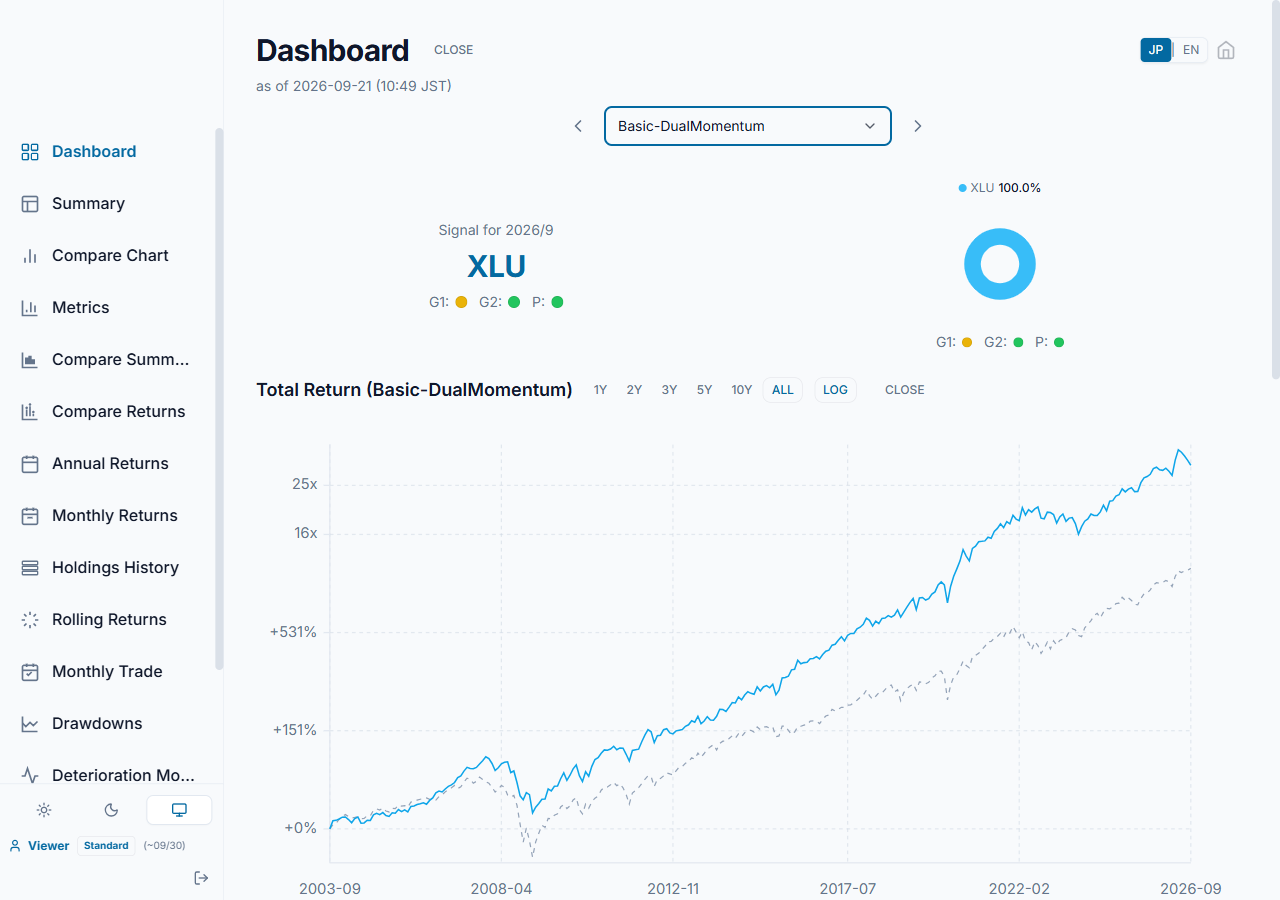
Live Basic-DualMomentum data
- 2026-10 holding
- XLU 100%
- Previous (2026-09)
- XLU
- Rebalance
- Not needed
- Last switch
- 2026-08: QQQ → XLU
- Holdings: ticker × weight
- Change since last month
- Rebalance or not
- Implementation notes
- Monthly notice on note
Members see the advanced portfolios in the same screens, next to Basic DM.
What members see, in detail →10 — Membership
Now it's only whether you'll use it.
The ×33 Basic DM (2003-09 – 2026-08) is free and public. Membership adds the advanced portfolios built on top of it.
Basic plan
¥1,000/month. Basic DM plus 5 more portfolios, with their monthly signals.
Standard plan
¥8,000/month. Advanced portfolios, with their monthly signals and weights.
Premium plan
By invitation. Additional portfolios and notes.
- Updates
- Monthly. Each signal is set by the last close of the previous month and published at the start of the month.
- Billing
- Sold as a note membership. Sign-up and cancellation happen on note.
- Always free
- Basic DM and the published evidence stay open whether or not you join.
11 — Questions
Questions, answered
What is Dual Momentum?
A rules-based strategy that holds the assets with the strongest recent returns and moves to a defensive asset when the market's own momentum turns negative.
How often do signals change?
Once a month. Each signal is set by the last close of the previous month and published at the start of the month.
How do you test a backtest?
Every backtest must survive small rule changes, hold up in periods not used to build it, and retain performance that is not explained by market exposure alone. Details are in the Trust Center.
What is free?
Basic DM: its rules, its current signal and its historical results, without signing up. It is a complete Dual Momentum strategy, not a demo.
Are returns guaranteed?
No. The results shown are backtests on historical data and do not promise future returns. This is not investment advice.
05 — Use
Used, not just researched.
Member counts are published on the membership page. No invented numbers, no faceless testimonials.
USER DATA Members still subscribed 12 months after joining
About 51%As of 2026-09-27. Estimated per person, for each member's first membership period, counted by billing month.
What you can check from the outside today